
Beer Types Chart
Lager or ale, IPA or stout, pilsner or porter? This interactive beer types chart lines up 40 common beer styles with their usual colour, strength (ABV) and bitterness (IBU), a short flavour description and food pairing ideas. Filter by family, colour or strength, sort the chart, or tell the finder what you like and see which styles to try next.
- Free to use
- No sign-up
- Runs in your browser
Beer style chart and finder
Beer Tasting Kit Printables
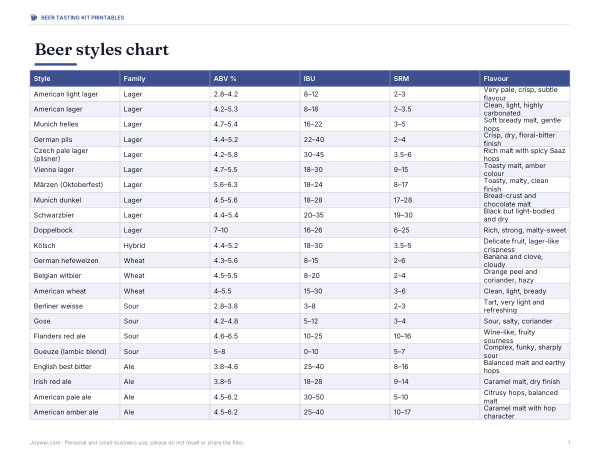
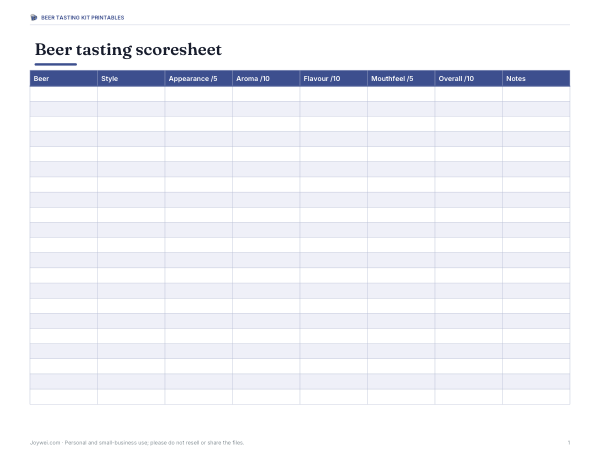
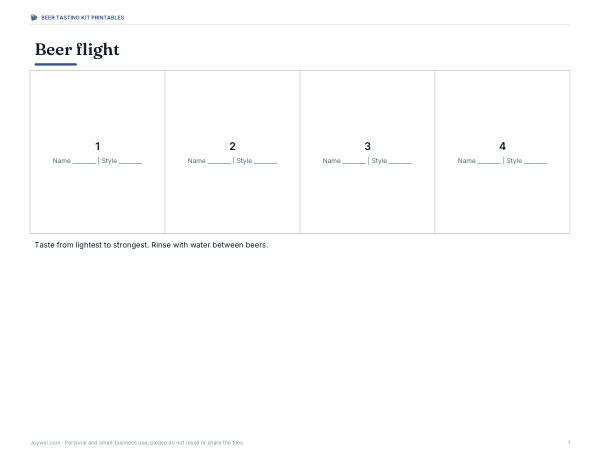
Printable beer tasting kit: beer styles chart, tasting scoresheets, a flight placemat for four beers, a beer and food pairing guide and a beer journal workbook.
- Styles chart (PDF/XLSX)
- Tasting scoresheet (PDF, XLSX)
- Flight placemat (PDF)
- Pairing guide (PDF)
- Beer journal (XLSX)
Formats: PDF, XLSX. Instant download after payment (link valid 72 hours, up to 5 downloads). AI-assisted: the templates were drafted with AI help and reviewed and laid out before publishing.
$5.00 USD, one-time 5 files · about $1.00 each
- Instant download
- 7-day refund
- Secure checkout by Stripe
7-day money-back guarantee. Full refund within 7 days of purchase, even after you download.
Free sample: Beer Food Pairing (PDF, 63 KB)
Full refund within 7 days — see the refund policy and license.
Free printables
Single sheets you can print right now, no sign-up. The full pack adds every sheet in one download plus the editable files.
 Printable Beer Pairing Guide
 Printable Beer Journal
Ales, lagers and the rest
Almost every beer is either an ale or a lager, and the difference is the yeast. Ales use top-fermenting yeast (Saccharomyces cerevisiae) at warmer temperatures, around 15–24 °C, which produces fruity and spicy flavours. Lagers use bottom-fermenting yeast (Saccharomyces pastorianus) at cooler temperatures, around 7–13 °C, followed by weeks of cold conditioning, giving a cleaner, crisper taste. Hybrids such as Kölsch are fermented like ales but conditioned cold like lagers. Wild and sour beers use bacteria and wild yeasts for tartness.
Reading the chart
| Measure | Meaning | Typical range |
|---|---|---|
| ABV | Alcohol by volume — the percentage of the beer that is alcohol | About 3% for light beers to 12% for strong ales |
| IBU | International Bitterness Units — a lab measure of dissolved hop bitterness | Under 10 for wheat beers to 100+ for double IPAs |
| SRM | Standard Reference Method — a measure of colour | 2 (straw) to 40+ (black) |
The ranges come from widely used style guidelines, such as those of the Beer Judge Certification Program (BJCP), and describe typical examples. Individual beers can fall outside them, and perceived bitterness depends on how sweet and full-bodied the beer is as well as its IBU.
How to use the chart and finder
- Choose a family — lager, wheat, ale, Belgian, dark or sour — or leave it on All.
- Filter by colour band, maximum strength and bitterness to match what you enjoy.
- Sort by colour, strength, bitterness or name.
- Read the flavour notes and food pairings to choose what to try next.
For example, if you like pale, low-bitterness beers under 5.5% ABV, the finder suggests lagers such as helles and wheat beers such as witbier and hefeweizen.
Worked example: finding a new favourite
Someone who enjoys American IPA but wants something less strong could set the family to Ale, bitterness to High and the maximum ABV to 6%. The chart then shows English IPA, American IPA and hazy IPA, sorted by strength; switching bitterness to Medium brings in American pale ale (4.5–6.2%) as a lighter choice. Someone who likes stout but finds imperial stout too strong could filter Dark with ABV up to 6% and find Irish stout, oatmeal stout and English porter.
Food pairing basics
- Match intensity: delicate beers with light dishes, big beers with rich food.
- Complement: roasty stouts with chocolate desserts, caramel ambers with barbecue.
- Contrast: tart sours cut through fatty or creamy dishes.
- Cut heat carefully: hoppy IPAs can intensify chilli heat; a lager or wheat beer cools it.
- Cheese: almost every beer style has a cheese partner — try tripel with brie or barleywine with blue cheese.
Serving temperatures and glasses
| Style group | Serve at | Glass |
|---|---|---|
| Light lagers and pilsners | 3–7 °C (38–45 °F) | Pilsner glass or tall flute |
| Wheat beers | 4–7 °C (40–45 °F) | Tall weizen glass |
| Pale ales and IPAs | 7–10 °C (45–50 °F) | Nonic pint or tulip |
| Amber, brown ales and stouts | 8–12 °C (46–54 °F) | Pint or snifter for strong stouts |
| Belgian and strong ales | 10–14 °C (50–57 °F) | Chalice or tulip |
| Sours | 6–9 °C (43–48 °F) | Tulip or stemmed glass |
Serving too cold hides flavour; strong and dark beers show more aroma a little warmer.
A short tour of beer families
- Pale lagers — helles, pilsner and American lager — are the world’s most popular beers: crisp, pale and refreshing.
- Amber and dark lagers such as Vienna, Märzen and dunkel add toasty and bready malt.
- Wheat beers use a large share of wheat malt for a soft, hazy body; German styles bring banana and clove from their yeast.
- British and Irish ales — bitters, reds, porters and stouts — balance malt with earthy hops.
- American ales showcase bold citrus, pine and tropical hops, from pale ale to double IPA.
- Belgian ales are known for expressive yeast: fruity, spicy and often strong.
- Sours range from light, lemony Berliner weisse to complex, barrel-aged lambic blends.
Hosting a tasting
Pour small samples of four to six beers, about 60–120 ml each, and taste from lightest and least bitter to darkest and strongest so bold flavours don’t overwhelm the delicate ones. Serve water and plain crackers between beers. Look at the colour and clarity, smell before sipping, and note sweetness, bitterness, body and finish. The printable pack includes scoresheets and a flight placemat.
Drink responsibly
Strength varies widely, from under 4% to over 12% ABV — a 330 ml bottle of imperial stout can contain three times the alcohol of the same bottle of light lager. Check the label, alternate with water, and follow your local guidelines for low-risk drinking. Never drink and drive, and do not drink if you are pregnant or under the legal age.
About the colour swatches
The colour swatches are approximate on-screen renderings of the SRM range for each style. Real beer colour also depends on the glass, the light and haze, so use them as a guide rather than an exact match.
Frequently asked questions
What are the main types of beer?
Lagers and ales, plus hybrids, wheat beers and wild or sour beers.
What is the difference between an ale and a lager?
Ales use warm-fermenting yeast and taste fruitier; lagers use cool-fermenting yeast and taste cleaner.
What does IBU mean?
International Bitterness Units, a measure of hop bitterness.
What is the strongest beer style on the chart?
Belgian dark strong, imperial stout and barleywine can reach about 12% ABV.
Is stout always strong?
No, Irish stout is often only about 4–4.5% ABV.
What beer is least bitter?
Styles such as Berliner weisse, gueuze, hefeweizen and witbier have low bitterness.
What is the difference between porter and stout?
They overlap a lot; stouts are usually more roasty and dry, porters more chocolatey.